
A healthy version of Bisi Bele Bath, the quintessential and most popular one pot rice dish from the Udipi Cuisine or Karnataka. Presenting Samba Godhumai Bisi Bele Bath or Broken Wheat Bisi Bele Bath.

Today's recipe is sheer comfort food. The quintessential and most popular one pot rice dish from the Udipi Cuisine or Karnataka. Presenting Samba Godhumai Bisi Bele Bath or Broken Wheat Bisi Bele Bath Recipe made with home made Bisi Bele Bath Masala Powder.

Samba Godhumai or Broken Wheat is usually consumed by Diabetics as they avoid rice. If you recall, I had posted a recipe of Samba Godhumai Pongal (Wheat Rava Pongal) in the month of January for the Pongal Festival. The post was a healthier twist to the regular Pongal Recipe which primarily uses rice.
I substituted samba godhumai instead of white rice and the result was a slightly guilt free breakfast or brunch. This recipe and post is particularly created for diabetics or in general senior citizens or health conscious folks who are simply trying to avoid rice and looking for suitable alternatives.
What is Bisi Bele Bath?
- It is a traditional Rice Recipe of Karnataka, part of the Udipi Cuisine.
- Bisi Bele Bath translates as "Hot Lentil Rice".
- The Recipe has elements like cooked rice (which is substituted here by Samba Godhumai / Broken Wheat), Cooked Tuvar Dal Or Arhar Dal, Cooked Mixed Vegetables of your choice, Tamarind Paste and most important, Bisi Bele Bath Masala Powder

We paired the broken wheat Bisi bele bath with the usual favourite accompaniments of my husband - Finely chopped onions mixed in curd and topped with generous amount of coriander leaves. And some home made avakkai pickle (last year batch).

I have used Ghee or clarified butter instead of oil for the recipe. Tastes great and is soul satisfying. Bisi Bele bath tastes best with ghee.
While you may opt for oil, the tadka or tempering has to be with pure ghee. There is a reason such recipes are called comfort food. Satisfies both the body and soul.
However, comfort food here is given a healthy twist with the addition of Samba Wheat instead of White Rice. It definitely feels lighter and no compromise in taste.

For this particular photo shoot, I cannot tell you how much I had to convince my husband not to attack the food until I had photographed as it turned out so delicious, flavourful with the freshly ground home made masala.
Narayan is extremely patient while I photograph and doesn't disturb me ever but I guess the food distracted him way too much (in a good way, I hope).
Check out the recipe below with step by step images of the process. Grind a batch of the masala and cook this healthier version for the entire family this weekend.
One pot, healthy, delicious mix of proteins in the form of dal, carbs, fat and spices. This is one dish you cannot miss!
Recipe for Samba Godhumai Bisi Bele Bath / Broken Wheat Bisi Bele Bath
(1) Wash and soak the Samba wheat for 15 minutes.
(2) Wash and soak the tuvar dal or Arhar dal for 15 to 20 minutes.
(3) Discard the soaked water, rinse the wheat and dal once. Remove excess water.
(4) Pressure Cook the samba wheat (1:1.5 cups of water) Check how fluffy and perfectly cooked the lapsi is.

(5) Also, pressure cook the tuvar dal with 1 cup of water (3/4 : 1)

(6) Now, pressure cook the vegetables and keep aside. Be careful not to overcook them.

(7) Heat a kadhai, add ghee and mustard seeds. Once they crackle, add hing.
(8) Now add the cooked vegetables, saute them for a few seconds.

(9) Add the cooked dal and Samba wheat along with some salt to taste.

(10) Mix well. Add tamarind paste, haldi powder, red chilli powder and the bisi bele bath powder.

(11) The bath will thicken and at this stage add some water to adjust the consistency. Cover and cook for 5 minutes on low flame.

(12) After 5 minutes, Check for salt, spice levels and add more if required.
(13) Switch off the flame and prepare for tempering.
(14) In a small pan for tempering, heat ghee or clarified butter. Crackle mustard seeds, roast chana dal and hing along with peanuts and curry leaves. Pour the tempering over the bisi bele bath just before serving.

Recipe Notes
- Samba wheat tends to thicken with time and hence it is important to adjust the consistency of the same by adding water and salt appropriately.
- I pressure cook almost all the vegetables with no water. That way the nutrients are intact. I have a 10 litre pressure cooker which cooks all the 3 ingredients together (in separate vessels with lid) and saves time, ensures even cooking. I tend to keep the vegetables for cooking always at the top so that they dont turn mushy. (as you can see from the picture)
- Bisi Bele Bath is primarily made with rice, you can follow the same recipe and use Rice instead of Broken wheat. You won't need to add a lot of water too in that case to adjust consistency. The proportion of Rice to water would be 1:2. Use short grain rice variety for best results.
- You can add a variety of seasonal vegetables.
- I have used pondy red chillies for the tempering. You can use any available as per your taste and preferences.
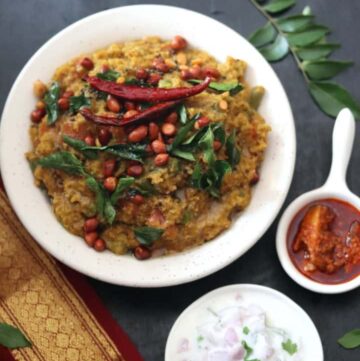
Samba Godhumai Bisi Bele Bath / Broken Wheat Bisi Bele Bath
Ingredients
- 1 cup Samba Wheat / Broken Wheat / Lapsi 1 cup is 250 ml measurement
- 3/4 cup Toor Dal, Tuvar Dal or Arhar Dal
- 3 cups Mixed Vegetables of your choice I have used carrots, peas and green beans
- 2 tsp Ghee or Clarified butter
- 1 tsp Mustard Seeds or Rai
- A pinch of asafoetida or hing
- 1 tbsp Tamarind Paste 1 tbsp is 15 ml measurement
- 1/4 tsp Turmeric Powder or Haldi Powder
- 1/2 tsp Red Chilli powder or Lal Mirch
- 5 tbsp Bisi Bele Bath Masala Use heaped tbsp
- Salt to taste
- Water as required to cook Check the steps below
- FOR FINAL TEMPERING
- 1/4 cup Groundnuts
- 2-3 nos Whole dry red chillies
- 4-5 nos Curry Leaves sprigs
- 1 tbsp Chana dal or Bengal Gram Dal
- 1/2 tsp Mustard Seeds or Rai
- 4 tbsp Ghee or Clarified Butter
- a pinch of asafoetida or hing
Instructions
- Wash and soak the Samba wheat for 15 minutes.
- Wash and soak the tuvar dal or Arhar dal for 15 to 20 minutes.
- Discard the soaked water, rinse the wheat and dal once. Remove excess water.
- Pressure Cook the samba wheat (1 wheat : 1 & 1/2 cups of water)
- Also, pressure cook the tuvar dal with 1 cup of water (3/4 lentils : 1 cup water)
- Now, pressure cook the vegetables and keep aside. Be careful not to overcook them.
- Heat a kadhai, add ghee and mustard seeds. Once they crackle, add hing.
- Now add the cooked vegetables, saute them for a few seconds.
- Add the cooked dal and Samba wheat along with some salt to taste.
- Mix well. Add tamarind paste, haldipowder, red chilli powder and the bisi bele bath powder.
- The bath will thicken and at this stage add some water to adjust the consistency. Cover and simmer for 5 minutes on low flame.
- After 5 minutes, Check for salt, spice levels and add more if required.
- Switch off the flame and prepare for tempering.
- In a small pan for tempering, heat ghee or clarified butter.Crackle mustard seeds, roast chana dal and hing along with peanuts and curry leaves. Pour the tempering over the bisi bele bath just before serving.
Notes
- Samba wheat tends to thicken with time and hence it is important to adjust the consistency of the same by adding water and salt appropriately.
- I pressure cook almost all the vegetables with no water. That way the nutrients are intact. I have a 10 litre pressure cooker which cooks all the 3 ingredients together (in separate vessels with lid) and saves time, ensures even cooking. I tend to keep the vegetables for cooking always at the top so that they don't turn mushy.
- Bisi Bele Bath is primarily made with rice, you can follow the same recipe and use Rice instead of Broken wheat. You won't need to add a lot of water too in that case to adjust consistency. The proportion of Rice to water would be 1:2. Use short grain rice variety for best results.
- You can add a variety of seasonal vegetables.
- I have used pondy red chillies for the tempering. You can use any available as per your taste and preferences.
If you try this recipe at home, please give me a shout out / Tag Me on any of my social media handles.
- Twitter - https://twitter.com/masalachilli
- Facebook Page - https://www.facebook.com/MasalachillibyVidyaNarayan/
- Pinterest - https://in.pinterest.com/masalachilli
- Instagram https://www.instagram.com/masalachilli_vidyanarayan/
Vidya Narayan
Leave a Reply